-
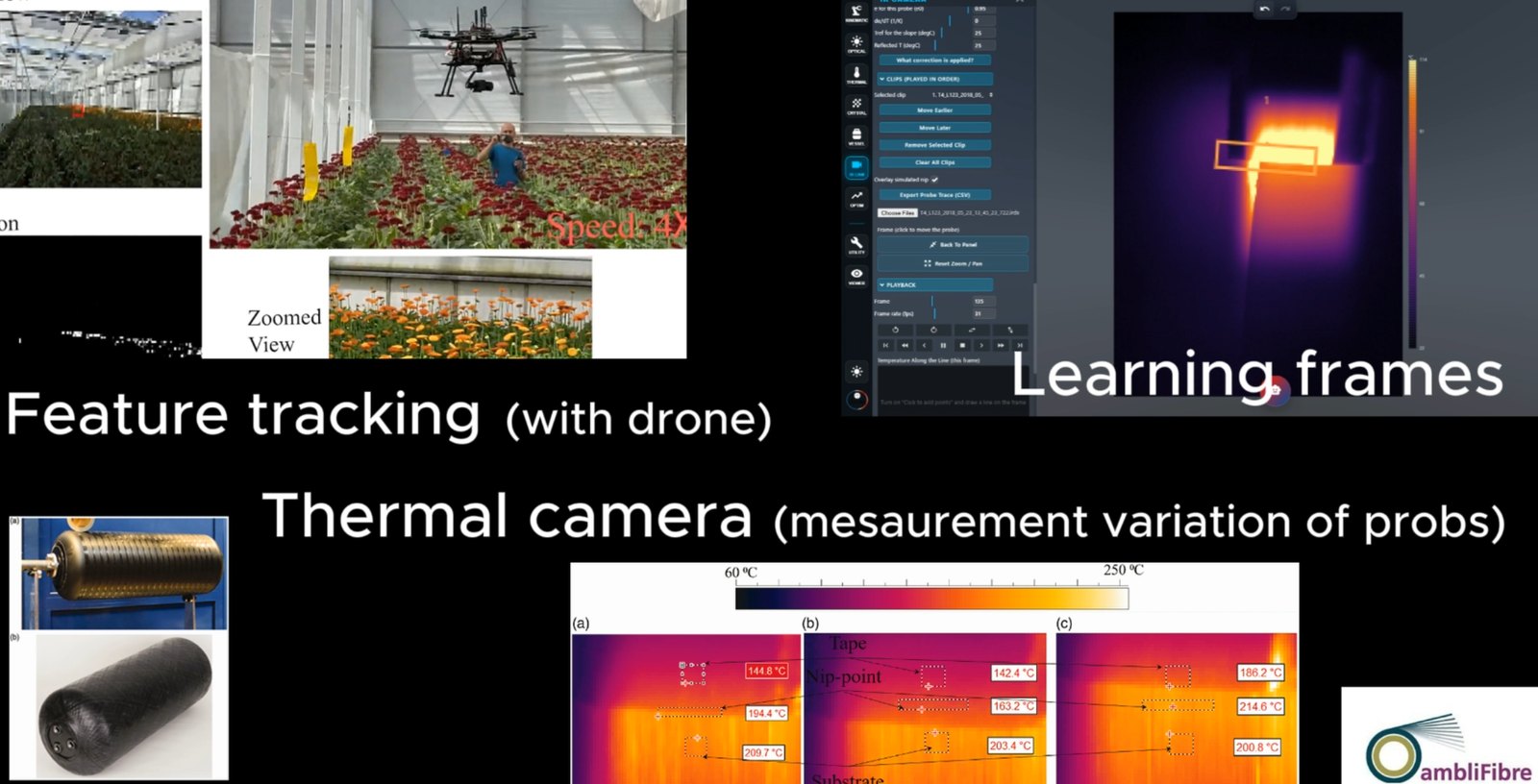
Emissivity is not a material constant. Get it wrong and your nip-point temperature is wrong by more than the process window you are trying to hold.
If you measure nip-point temperature in automated fiber placement with an infrared camera, the emissivity value you enter matters more than most process engineers expect — and it is not a fixed number you can read off a datasheet.
On the same thermoplastic tape surface, in the same frame, the difference is stark:
That is an 83 °C swing from a single setting in a menu. It lands squarely in the range where you are deciding whether consolidation is adequate, whether the matrix has degraded, or whether a course should be reworked.
The direction surprises people. A lower emissivity setting produces a higher reported temperature, because the camera attributes the measured radiance to a surface that emits less efficiently — and therefore must be hotter to produce the same signal.
Emissivity describes a surface’s ability to emit infrared radiation. For thermoplastic prepreg it varies with:
This is the awkward part: the property you must know in order to measure temperature is itself a function of temperature.
Thermography remains valuable, but it should not be the only source of truth. Practical approaches include calibrating against thermocouples at actual process temperature rather than at ambient, using two-colour pyrometry to reduce emissivity sensitivity, and cross-checking measurements against a physics-based thermal model.
A physics-based optical-thermal model predicts the nip-point temperature from first principles — laser intensity distribution, material optical properties, contact conditions and placement speed — rather than inferring it from radiance. Used alongside a camera, it gives an independent reference that does not depend on an assumed emissivity value. This is the approach behind the OTOM optical-thermal ray tracer.
Related reading: Emissivity in AFP, Laser intensity profiles, and Thermal contact resistance.
