Sustainability & Industry 4.0
Lighter thermoplastic composite products, made right the first time, and designed with simulation instead of scrapped trials. That is how OTOM reduces material, energy and waste across the production cycle.
Thank you for reading this post, don't forget to subscribe!Replacing metallic reinforcement layers with thermoplastic fibre-reinforced plastic (FRP) makes pipes, vessels and structures lighter and recyclable. The benefit only holds if the product lasts, and that depends on bond quality, which depends on controlling the nip-point temperature. A physics-based model is the most reliable way to get there without wasteful trial and error.
Four levers for sustainable production
Lighter, longer-lasting products
Thermoplastic FRP replaces metal layers. Correct consolidation of the bond line extends the service life of LATW and LATP products such as hydrogen tanks and pipes.
Right first time
Predicting the process window removes most trial lay-ups, along with the scrapped tape, machine hours and energy they consume.
Better buildings and equipment
OTOM CFD and SPH optimise ventilation, mixing and filling virtually. In one case study, better greenhouse ventilation meant less moisture, mould and rot, and a higher yield.
Lean computing
Optimised GPU code runs on the hardware you already own. No solver farm and no data transfer: a full AFP thermal run takes about 6 seconds instead of 32.
Adaptive nip-point tracking with the thermal camera
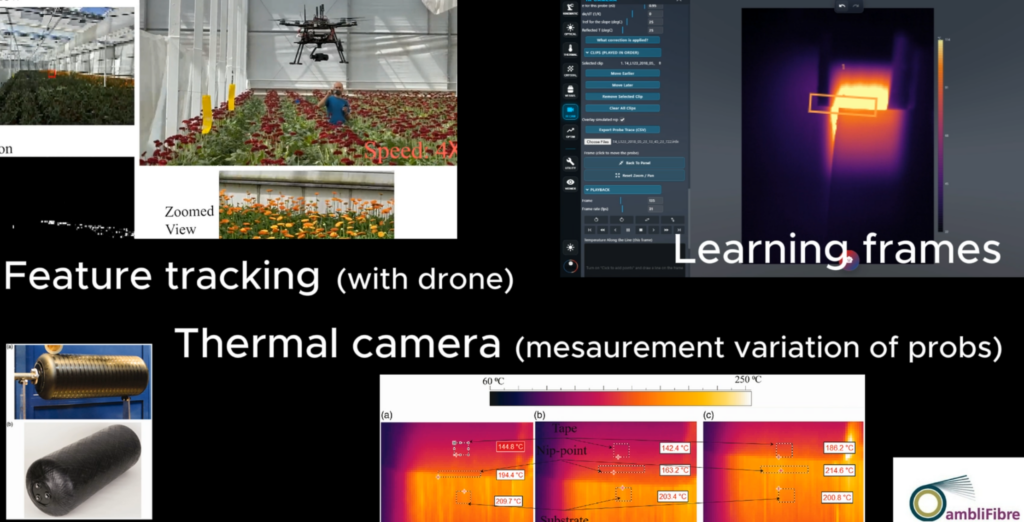
Controlling the nip-point temperature only helps if it is measured in the right place. On a moving laser head the nip point shifts from frame to frame, so a probe fixed in the thermal image soon reports the tape or the substrate instead of the bond line. In a single IR frame, probes on the tape, the nip point and the substrate can differ by tens of degrees, and that uncertainty is what leads to repeated trials.
OTOM therefore tracks the nip point adaptively. Feature tracking moves the probes with the nip point through the recorded frames, learning frames keep the trace stable, and the simulated nip point from the physics-based model is overlaid on the measurement for direct comparison. The resulting temperature trace can be exported frame by frame and used for process settings and feedback control.
Industry 4.0: the digital thread
OTOM connects design, simulation and the shop floor:
- Digital twin: the machine programme, kinematics, optics and thermal history in one model.
- In-line monitoring: live thermal-camera streams compared with the simulation.
- PLC integration: process data exchanged with TwinCAT over ADS for feedback control.
- AI agents: local or cloud models that set up and run analyses on request.
Make your next product lighter and right first time
Talk to us about a pilot study on your process.