What OTOM Stands For
Optimizing Thermo-Optical Modeling. Born in the EU H2020 ambliFibre project, OTOM turns physics into fast, validated software: numerical simulation, digital twins and real-time computing on parallel hardware.
Thank you for reading this post, don't forget to subscribe!We build simulation software that answers in time to act on. That means three things done well together: the right physics, the right numerical method, and code written for the parallel hardware it runs on.
Our expertise
Numerical simulation
Finite differences, finite elements and finite volumes; projection methods and HLLC Riemann solvers for flow; weakly compressible SPH; and Monte Carlo ray tracing with Fresnel optics. We choose the method per question, and every solver is checked against analytical solutions and experiments.
Digital twins
Models that follow the real machine: robot and head kinematics read from the G-code, the laser optics, the thermal history of every ply and the resulting crystallinity, compared with thermal-camera recordings and connected to the PLC (TwinCAT ADS).
Optimised code for real time
Real-time is designed in, not bolted on: reduced models where the physics allows, exact line solvers instead of general ones, skipping settled regions, and overlapping independent work so the processor never waits.
Parallel GPU computing
From NVIDIA CUDA in our desktop software to WebGPU compute shaders today: conjugate-gradient solvers, parallel prefix-sum sorting, fused flux kernels and GPU ray tracing, running on any modern graphics card through a web browser.
How we make physics run in real time
Model only the physics that decides the answer
We start from the engineering question, such as nip-point temperature, drag or melt mixing, and keep the effects that change it. The rest is reduced analytically.
Pick numerics that suit the hardware
Explicit, local updates parallelise well, and implicit solves converge fast. We choose per sub-model, for example a GPU conjugate-gradient solve for the substrate and an exact line solver for the incoming tape.
Parallelise on the GPU and pipeline the rest
Work that does not depend on the previous result is queued ahead. In AFP Web the laser trace for the next station runs while the current station’s heat equation is still solving.
Prove it gives the same answer
Each GPU path is cross-checked against the CPU reference and falls back automatically if it disagrees. A built-in solver lab validates against analytical solutions.
From research project to product
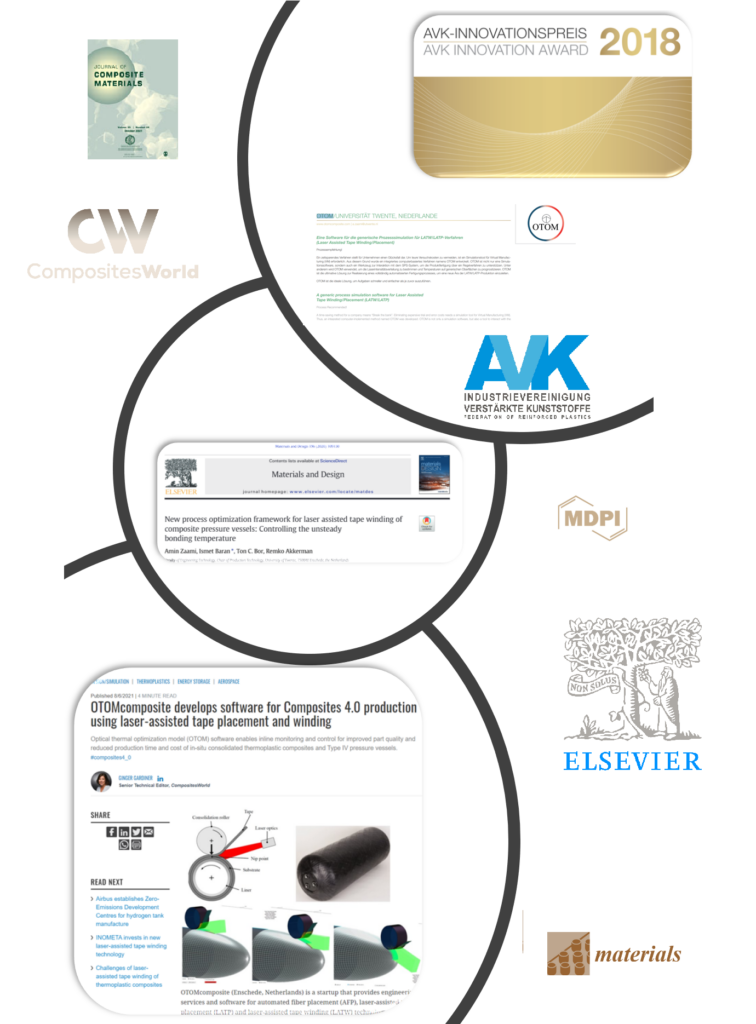
OTOM began in 2016 inside ambliFibre (H2020-EU) as the adaptive, model-based control for laser-assisted tape winding of composite pipes and vessels. It was the project’s first software to be designed, implemented and validated.
- Challenge: predict the temperature field in laser-assisted composite production in real time, with millisecond response, for in-line monitoring.
- Approach: new algorithms that discretise the optical and thermal boundary conditions intelligently, developed with industrial partners and validated remotely on their experiments.
- Result: real-time in-line prediction, in-process and offline optimisation, and publications in journals and conferences.
Since then OTOM has become a standalone product line, from OTOM AFP V.1.x on CUDA to today’s browser-based AFP Web, CFD and SPH engines.
Have a process that needs a faster answer?
Tell us the question. We will tell you which model and which hardware can answer it, and how fast.