Documents
Technical background, scientific publications, user guides and case studies for OTOM AFP Web, OTOM CFD and OTOM SPH, all in one place.
Thank you for reading this post, don't forget to subscribe!Physics-based software for thermoplastic composites
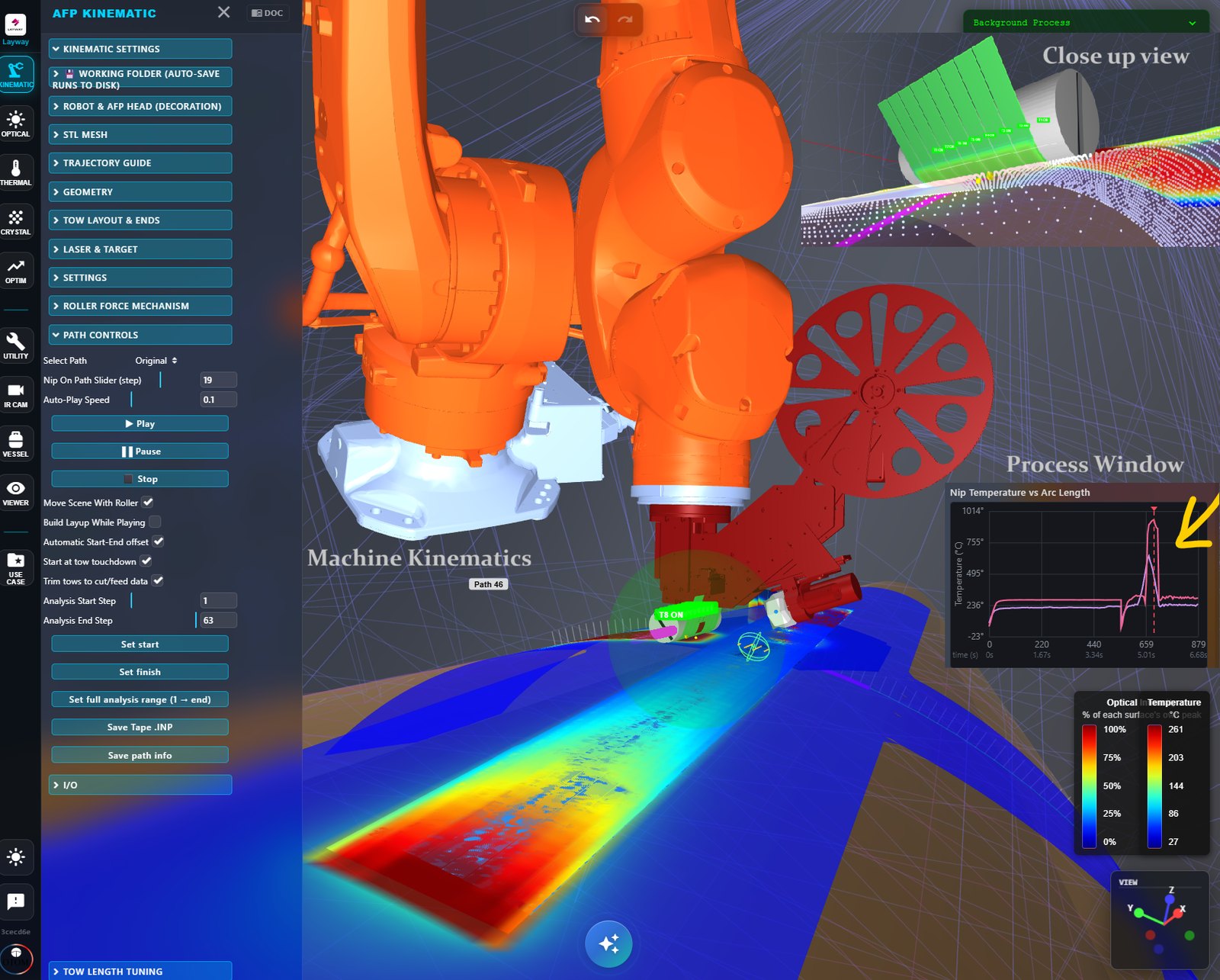
OTOM was built for laser-assisted fibre placement and tape winding of thermoplastic tubes, pressure vessels and aerospace parts. It addresses the three things that decide part quality:
- Temperature localisation: optical-thermal analysis predicts the temperature distribution, heat transfer and cooling rate at the bond line.
- Tailored laser intensity: laser power and source position are optimised per station for consolidation and crystallinity.
- In-line monitoring: simulation is linked to the PLC and the thermal camera to detect deviations and adjust in time.
Technical documentation
Technical notes
The optical-thermal model for LATW and LATP: in-line process modelling, computational efficiency and PLC integration.
Read → ResearchScientific papers
Peer-reviewed journal and conference papers behind OTOM: validation, simulation and optimisation.
Read → EngineeringTechnical feasibility
How we evaluate a project, the model inputs and outputs, and the CFD, SPH and GPU methods we use.
Read → TechnologyOur technology
The three engines (AFP Web, CFD and SPH) and the WebGPU computing behind them.
Read → ManualsUser guides
Manuals for the legacy desktop tools: OTOM Ray-tracer, AFP Viewer and AFP Engine, to read inline or download.
Open → LearnVideo tutorials
Step-by-step videos, from loading geometry and G-code to optical analysis and AI agents.
Watch →Applications and case studies
Applications
Hydrogen tanks, aircraft fuselages and high-resistance oil and gas pipes.
Read → Case studyOptimisation on a vessel
Holding the bonding temperature within 1.5 °C across the cylinder and domes of a pressure vessel.
Read → Digital twinReal-world simulation
Industrial geometries and machine programmes, simulated on the GPU, plus CFD and SPH examples.
Read →Process physics
Residual stress
How thermal history drives stress in placed layers.
Contact resistance
Temperature drop between layers.
Inline monitoring
Feedback-loop control with TwinCAT.
Sustainability
Lighter parts, right first time.
Fluid and particle simulation: OTOM CFD and OTOM SPH
Beyond composites processing, OTOM offers two general-purpose simulation tools that run on the GPU directly in the web browser, with nothing to install.
Fluid dynamics in the browser
2D and 3D flow on the GPU: incompressible flow with LES turbulence models, a compressible solver for shock waves, heat and buoyancy, fans and rotating parts, and STL/OBJ mesh import. Live drag and lift, checks against textbook results, guided tours and an AI assistant. Any run can be rendered photoreal in Blender.
Open → OTOM SPHParticles, liquids and powders
Smoothed-particle hydrodynamics on the GPU for free-surface liquids, granular materials and mixing: powders and beads in moving machinery, solids carried by liquid, sloshing and stirred tanks. Runs in the browser and renders in Blender.
Open → ExamplesDemo gallery and slides
Blender renders of the CFD and SPH demo scenes, and the OTOM CFD demo slides with physics notes and validation results.
View →Demo slides (PDF)
39 slides: every CFD demo with what it shows, the physics and validation.
Videos
CFD highlight reel and clips.
Methods
How CFD, SPH and GPU computing are used in a project.
Technology
The AFP Web, CFD and SPH engines.
Looking for something specific?
Ask us for datasheets, validation reports or a tailored technical presentation.