Value Proposition
Physics-based simulation that is fast enough to use while decisions are being made, so you can get a composite process, a flow design or a mixing step right before the first physical trial.
Thank you for reading this post, don't forget to subscribe!Most manufacturing problems are solved by trial and error because the important quantity cannot be seen: the temperature at the bond line under the roller, the flow behind a vent, the melt between two fibre bundles. OTOM makes those quantities visible and predictable.
What OTOM delivers
See what sensors cannot
Nip-point and through-thickness temperatures, laser shadowing, crystallinity, pressure and velocity fields, beyond the reach of a thermal camera or a probe.
Answers in seconds
GPU-accelerated solvers return a full AFP thermal run in about 6 seconds and run CFD and SPH live, so you can explore variants instead of waiting for overnight runs.
Validated physics
Models built from analytical and numerical methods, calibrated on experiments with thermoplastic composites and checked against manufactured parts.
One model for the whole LATW/LATP chain
OTOM links kinematics, optics, heat transfer and crystallisation in one fast model, suitable for offline optimisation and for in-line monitoring and control of bonding quality. We know of no other commercial tool that covers this whole chain fast enough for in-line control.
Benefits for your organisation
- Predict and control the process instead of reacting to it
- Uniform bonding through a laser power profile tailored to the part
- Fewer destructive and non-destructive tests
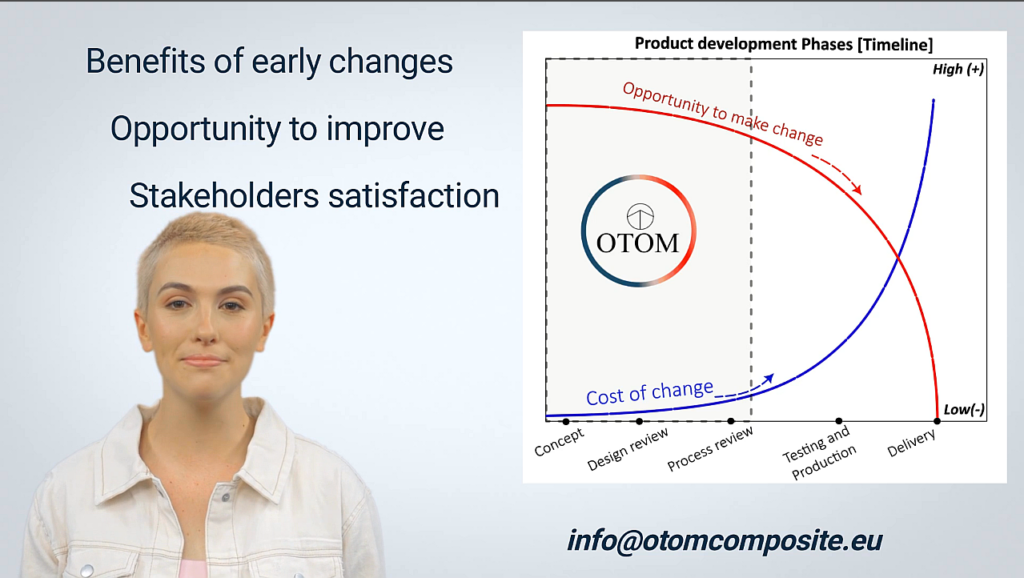
- Shorter trial-and-error loops, towards one-shot production
- Identify the best process parameters early in development
- Faster training of engineers and operators
- Up to 50% less raw material spent on trials
- Less waste, tooling, machine time and labour
- No hardware investment: the software runs in the browser
- Lighter thermoplastic composite parts with longer service life
- Lower lead times and a smaller environmental footprint
- A digital thread from design to the PLC on the shop floor
Trial and error versus OTOM
| Conventional approach | With OTOM | |
|---|---|---|
| Process window | Found by physical trials and scrapped parts | Predicted, then confirmed with a few targeted trials |
| Bond-line temperature | Estimated from a camera that cannot see the nip point | Simulated at the nip point and through the thickness |
| Flow and mixing studies | Overnight CFD runs on a workstation | Interactive CFD and SPH in the browser |
| Know-how | Held by a few experienced operators | Captured in a model the whole team can use, with AI assistance |
See the value on your own part
A pilot study on one of your parts or cases is the quickest way to measure it.