Westerstraat, 7522 DJ Enschede, Netherlands

Call Us

Mon-Fri 8:00AM-6:00PM

OTOMcomposite

  • Products
    • Background
    • Our Technology
    • Product List
    • CFD-Tool
    • SPH-Tool
    • Book a Demo | Pilot study
    • Downloads
    • Engineering Service
    • Product feedback
  • Story
    • Application
    • Value Proposition
    • Technical Feasibility
    • Sustainability and Industry 4.0
  • Documents
    • Ai Agents
    • Real-world simulation
    • Optimization case
    • Video Tutorials
    • Technical Notes
      • Inline Monitoring
      • Thermoplastic tape
      • Contact resistance
      • Laser intensity
      • Emissivity
      • Feed rate velocity
      • Residual stress
    • Media
      • Image Gallery
    • Papers
    • Guide Docs
  • News
    • Events
    • Updates
    • Vacancy
  • About
    • Company presentation
    • Contact us
    • Trusted by
    • Projects
    • Privacy Policy
Westerstraat, 7522 DJ Enschede, Netherlands
Call Us
Mon-Fri 8:00AM-6:00PM

-

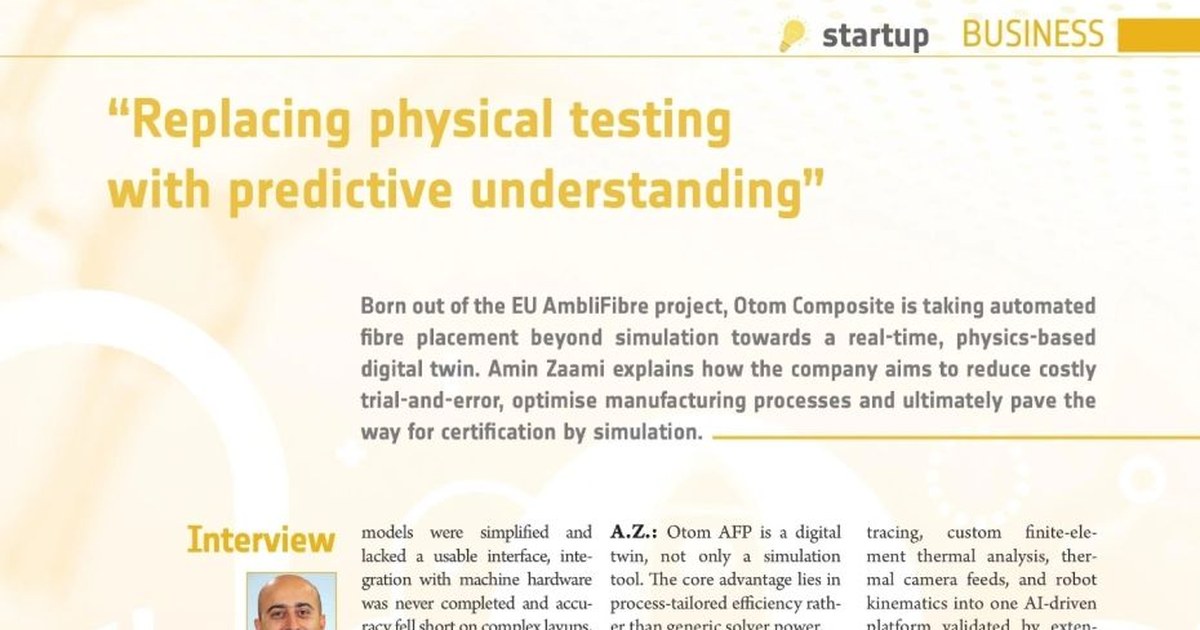
JEC Composites Magazine N°171 startup interview with Amin Zaami of OTOMcomposite: Replacing physical testing with predictive understanding
  • News
post by admin Oct 23 2026 0 Comments
OTOMcomposite Featured in JEC Composites Magazine N°171

JEC Composites Magazine N°171 startup interview with Amin Zaami of OTOMcomposite: Replacing physical testing with predictive understanding
JEC Composites Magazine N°171, Business › Startup, pages 11–12

We are honoured to be featured in JEC Composites Magazine N°171 (November–December 2026), the Aeronautics & Space issue of the leading magazine of the composites industry. In the Business › Startup section, our founder Amin Zaami, Ph.D., talks to JEC about how OTOM grew out of the EU AmbliFibre project and where it is heading, under the headline “Replacing physical testing with predictive understanding.”

Thank you for reading this post, don't forget to subscribe!

JEC describes OTOM as taking automated fibre placement (AFP) “beyond simulation towards a real-time, physics-based digital twin”, to reduce costly trial-and-error, optimise manufacturing processes and ultimately pave the way for certification by simulation. Below are the highlights of the interview.

From an EU research project to a company

The EU H2020 AmbliFibre project set out to make AFP a monitored, closed-loop process: a validated model fast enough to drive a feedback controller alongside live measurements. It reached a minimum viable product, but three gaps remained. The models were simplified and had no usable interface, integration with the machine hardware was never completed, and accuracy fell short on complex layups, where industry needs it most. OTOMcomposite was founded to close that gap and take the work past the demonstrator stage into a real digital twin platform.

A digital twin, not just a simulation tool

As Amin puts it in the interview, the core advantage is “process-tailored efficiency rather than generic solver power.” OTOM AFP combines optical ray tracing, custom finite-element thermal analysis, thermal camera feeds and robot kinematics in one AI-assisted platform, validated by extensive testing. It replaces manual FEM workflows with direct Design for Manufacturability (DFM), so engineers can check layup strategies and process windows before touching hardware.

  • Why it matters: a single AFP trial can cost well beyond €100k depending on the size of the structure. A few targeted experiments anchor the model, and the platform finds the settings that iteration would otherwise chase.
  • Optical-thermal physics for LATP/LATW: ray tracing over the true nip geometry gives the absorbed energy that drives DFM, predicting thermal overshoot, cold regions that cause bond defects, and full thermal histories.
  • Material behaviour: non-isothermal kinetics calibrated by DSC predict the degree of crystallinity in PEEK, PEKK and PPS, and the model resolves the subsurface interfaces in multi-ply layups where thermal gradients drive out-of-plane behaviour.

Markets: aerospace, hydrogen and UAVs

Aerospace (civil, defence and space) is the primary market, with a focus on large thermoplastic structures such as fuselages, where predictive modelling prevents high-cost part failures. OTOM also models Type IV hydrogen vessels and pipes, including ellipsoidal domes with hoop and geodesic winding, capturing the re-visit effect that builds up thermal history over repeated passes. UAV manufacturing, with larger airframes and primary sub-components, is a growing third segment.

Fast, evidence-based DFM sign-off

By importing robot paths directly, teams can evaluate hundreds of process variants (power schedules, layup sequences and thermal histories) in days rather than months of physical testing. Beyond geometry, the platform audits trajectory quality against heat- and pressure-induced tape widening, and flags gaps, overlaps and steering defects on laid tows so they can be corrected before production. Next on the roadmap is coupling trajectory analysis with predictive tape-deformation models.

AI where it helps, physics where it counts

With real-time GPU computing, OTOM uses AI in two places: a natural-language interface that streamlines engineering workflows, and computer vision that maps thermal camera data directly into OTOM’s feedback controller. AI is deliberately kept out of the predictive calculations themselves. All physics, mathematics and experimental data stay strictly deterministic, so the AI only ever works on verified results.

Together with AFP machine builders and research centres such as Fraunhofer IGCV and Layway, OTOM is building a standardised framework for simulated process evidence, based on verified test cases, standardised process manufacturing libraries and reproducible, audit-ready data.

The long-term vision: three stages

  1. Prediction: upfront DFM validation using deterministic physics.
  2. Closed-loop control: the digital twin synchronises with thermal cameras to self-correct during production.
  3. Certification by simulation: standardised digital process evidence that replaces physical test articles and cuts qualification from years to months.

The goal, in Amin’s words, is to put “physics-based digital twins in the hands of every composite engineer within five years.”

Read the full interview

  • Article preview on jeccomposites.com
  • JEC Composites Magazine N°171, pages 11–12 (free JEC account required)

Special thanks to JEC, Fraunhofer IGCV and Layway.

Explore our tools: AFP Demo · Real-time CFD · Book a demo

Originally shared on LinkedIn.

0 Comments

-

Copyright © 2026 OTOMcomposite | Powered by Otomcomposite WordPress Theme